
Note to Self
This is a blog that strives to give those of us who suffer from eating disorders various tools and tips to help us in our recovery journey. NOTE: Everything posted on this blog are MY thoughts and experiences, and should not replace professional advice. You should consult professionals who are experienced in the treatment of eating disorders.
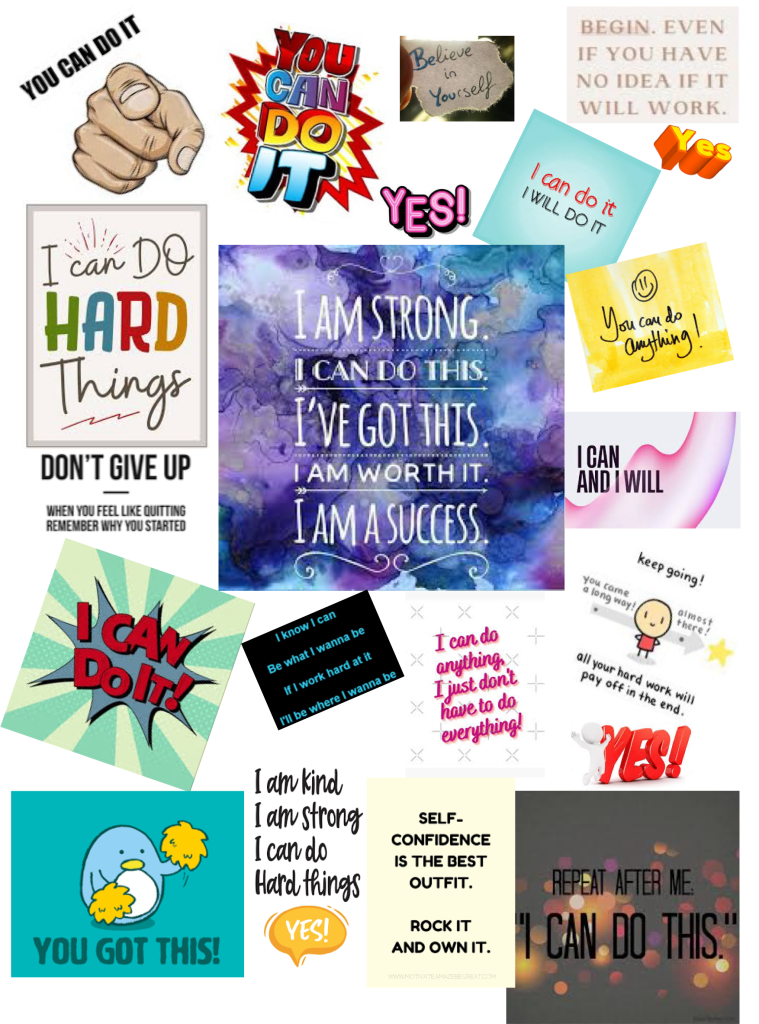


I have created over 120 vision boards in the past 2 1/2 years. These have served to remind myself in the many areas I struggle with that I can handle whatever it is. At times I have even printed them out and put them where I can easily see them. A visual reminder works wonders for me. I have put out a handful of them on here for you, with more to come. Feel free to print any of them out if you find they are helpful to you. Or you can simply use them for ideas on how to make your own vision boards using whatever medium you choose, whether it is drawing, painting, scrapbooking or cut and paste using the internet. Sometimes I will even put the lyrics to a song that speaks to me and encourages me to keep on going. At times my vision board consist of only pictures that speak to me on the topic I need to express. Your options are limitless.
FINAL THOUGHTS:
I know and believe that those of us who suffer from an ED of any type can beat it. It is hard work and at times feels impossible; but I am sure it is a goal that is obtainable to all of you out there.
KEEP YOUR CHIN UP! Take baby steps towards your recovery, put one foot in front of the other and know, with a capital K, you CAN do it. Even if you can’t see it now, the world needs you!

Journaling is a tried and true method to help us get out and deal with all of the negative emotions that fly through our minds. It is also a great way to keep track of our progress. When we write out our thoughts, both negative and positive ones, it allows for more consideration, greater clarity with complex ideas. It also helps our brains to process and believe our thoughts even more than if we just verbalize them. When we just speak our thoughts it is usually more spontaneous and we are less careful of the words we use and even less aware of how our brain processes them.
Journaling encourages a much more thorough way to communicate our thoughts, feelings and emotions making it easier to follow a logical progression. The act of physically writing down your thoughts can stimulate deeper cognitive processing and help you gain a better understanding of your own ideas. It also allows you to bring the journal to any meetings you have with your professional support team. This allows them to know what you were really thinking and feeling at the time. As we know, we usually have so much to say when we meet with our support team that it is easy to forget something important as well as to no longer feel the feelings and emotions to the depth we felt them at the time of our journaling.
Journaling does not always have to be in the form of writing out our thoughts. For some of us, this can be too painful or even allow us to stay focused on our pain. There are other ways we can express our thoughts such as drawing, vision boards, painting or any combination of the various types of journaling.
Vision boards can be created with any numbers of apps that allow creativity. This is my preferred method. It allows me to put together memes, quotes, songs and pictures that express my thoughts at the time. They are also much easier for me to give to my psychologist and quicker for her to get the idea of what I was feeling at a glance. The app I use is Zinnia. This app is not free; but the cost is not all that much and is not prohibitive for me. Most apps you will find for this type of journaling will also allow you to use it for straight journaling if that is your preference.
Drawing or painting out your thoughts can prove to be a very beneficial way to express yourself. I can’t draw, even stick people, so I chose not to use this method. But if you are a person who can draw or paint and enjoys doing so, then by all means, express yourself this way. There is some proof that drawing or painting is as therapeutic as actually journaling. There are apps and books out there to help you if you choose this method though you don’t have to use them if you feel you don’t need them. Some mental health professionals are even trained in this method. You might even think about seeing if you can find a class that utilizes this method, if you are in place to be able to financially afford it. Not areas will have classes for this though, so you may want to google this if you are interested in a class.
Remember your journaling can be just for you to express yourself if that is what you chose. Most apps have a feature where you can set up, if you want, to put a password needed to access it. This ensures no one can access your deepest and inner most thoughts without your permission. If you are in any type of professional help you might want to check with them. They may have ideas as to what type of journaling, if any, that you might want to try.
Happy journaling!
FINAL THOUGHTS:
I know and believe that those of us who suffer from an ED of any type can beat it. It is hard work and at times feels impossible; but I am sure it is a goal that is obtainable to all of you out there.
KEEP YOUR CHIN UP! Take baby steps towards your recovery, put one foot in front of the other and know, with a capital K, you CAN do it. Even if you can’t see it now, the world needs you

For those of us who suffer from an ED, our eating disorder became our ‘higher power’ whether we wanted it to or not. This disease because the strongest thing in our lives, dictating our every thought, feeling, emotion, and action. We looked it to “change our life”, to offer us security, to guide us. It dictated how we acted and reacted to all things that impacted us, situations and our lives. All of the decisions we made were based on what the ED told us was the best for us. Our eating disorder became the ‘end all – be all’ and the most important thing we turned to in times of stress, joy, sadness, happiness and yes even excitement. I am here to tell you that ED lies!
Our higher power never causes us to act in a manner that is so contrary to our real value system. Nor will it cause us to become someone that we do not recognize and have no idea ‘who we are‘. A true higher power will never encourage us to act in such unhealthy ways. It would never encourage us to isolate ourselves. It would never help us to continue on our journey of self-hatred. No higher power wants us to fail. ED lies!
A higher power helps to encourage us to be the best we can be; to become someone that we ourselves can be proud of. It can help calm us in moments of distress and uncertainty. It allows us reach for inner peace. It can increase (NOT DECREASE) our faith and belief in ourselves. It should be someone/something that we can reach for when we are at our wit’s end and to keep moving forward. A higher power should want us to survive and thrive.
Some people call their higher power God. Others call it the universe or Mother Nature. Regardless what name you put on your higher power, it is a massive power that guides us in our journey of recovery. I cannot tell you what or who your higher power should be; that is a very personal choice. But I am here to tell you that it can be one of the most powerful tools in your tool box. Talk to it; tell it your troubles, fears, anxieties and negative emotions. Then listen in the quietness. Sometimes the answers to what you are experiencing will come to you quickly. Other times you will just have to be quiet and trust that your higher power will send you the answers that will come to you in time. At times the answers will be in a form you are not expecting such as a person who says the exact thing at the exact right time. Or maybe an ah-ha moment you have yourself. Your higher power will always give you what you NEED; not necessarily what you WANT. Converse with it and be patient.
FINAL THOUGHTS:
I know and believe that those of us who suffer from an ED of any type can beat it. It is hard work and at times feels impossible; but I am sure it is a goal that is obtainable to all of you out there.
KEEP YOUR CHIN UP! Take baby steps towards your recovery, put one foot in front of the other and know, with a capital K, you CAN do it. Even if you can’t see it now, the world needs you.

Many of us have lived our lives while in the clutches of our ED in isolation both physically and mentally. We have lived our lives filled with fears and distrust. Though we don’t necessarily believe it, our friends and family can be one of our biggest allies and sources of support. Deciding who to turn to in times of need can be very hard and discouraging especially if we have no relationship with our family. Or our circle of friends is very small. There is no ideal number of persons who you turn to. This is based on your personal life. It can also be influenced by our relationship with our family and friends.
How do I know who to include on this team? We are, as a group, very afraid that the people in our lives will not fully understand our struggle and/or offer what we consider unhelpful advice such as “Just eat!” ( I have heard this so many times I wanted to scream at them) . Many of us also have the major concern that we will become a huge burden to them and that at some point they will turn their back on us. In our mind the fear of being criticized by these people can feel real.
Minimize the above concerns by using some criteria when choosing who to trust with your struggle and journey into recovery. These persons should be caring, patient and compassionate. You should be able to trust them with your thoughts, fears and concerns. Having them educate themselves about your particular type of ED goes a long way to your friends and family being able to provide positive support. Allow them to set their own boundaries when it comes to support and try your best to honor them. Let them know what is and is not helpful to you. At the times you are unable to reach out for whatever reason, please turn to your professional support. Remember, very few of us, if any, can do this alone!
In Person or On-Line Support Groups
Support groups may be another way we are able to get the support we need to beat this disease though they may not be for everyone. A quick internet search can give you many ideas for online support groups. Read how each group is set up before making a decision on which one(s) might be right for you. Reach out to your professional team. They may be aware of other support groups you have not found in your search, especially in your area.
NOTE: Any type of group may prove to be triggering; if you find this to be true, stop attending and discuss your anxiety with your professional team.
The online groups provide support in a less personal way. By this I mean there is a degree of separation since the groups on line are not face to face which can make it much easier for those of us who have ‘people’ issues. There are different on-line types of groups. Some online groups are set up by a specific treatment facility and may have more stringent rules about the words used during the meeting so participants are not triggered. These are set up as an ongoing method of support for their alumni only and you may have to request to be part of the group. Check with our treatment facility to,see if they have such a group. These groups will often have a specific topic for discussion during that meeting. Other online groups such as listed below are open to anyone.
NEDA Helpline
Call, text, or chat for support and guidance (https://www.nationaleatingdisorders.org/).
Recovery Instagram/Facebook Groups
Many positive communities exist for encouragement and shared experiences.
Reddit (r/EatingDisordersRecovery)
A space where individuals share recovery stories and tips
There are other on-line groups that are set up as ‘chat rooms’ where the user can reach out any time day or night and just chat about their struggles, progress, issues or whatever is on their mind hopefully relating to an ED. These type of groups allow other users to give you feed-back, encouragement and hopefully the support you may need at the time. These groups don’t always provide instant responses so please keep that in mind if you decide to explore this avenue. These people don’t know you and your issues and/or triggers, so the responses you may get back may or may not be helpful. Also, from personal experience I have found that these groups can be very triggering. Remember, you are chatting with persons who could be from all over the world, in many different stages of their recovery journey and maybe not be in recovery at all,at this time.
Blogs can be a great sense of on-line support. There are numerous blogs out on the internet which may be helpful and provide tools and tips you were unaware of. Some of these blogs also contain ‘success stories’ from others who hove gone through an ED to help keep you believing/knowing ‘you can do this’. Most helpful blogs will be written in such a way so that you are not triggered when reading them. If you find yourself being triggered, stop reading, breathe, and reach out to someone on your support team before you are tempted to resume the behavior your eating disorder wants you to believe will be helpful.
In person groups such as Over-Eaters Anonymous are also available and free of charge. These groups are NOT just for people who over eat but rather for all persons who suffer from an eating disorder.
FINAL THOUGHTS:
I know and believe that those of us who suffer from an ED of any type can beat it. It is hard work and at times feels impossible; but I am sure it is a goal that is obtainable to all of you out there.
KEEP Y0UR CHIN UP! Take baby steps towards your recovery, put one foot in front of the other and know, with a capital K, you CAN do it. Even if you can’t see it now, the world needs you!

Music can be a very powerful tool we can use. I find music says to and for me what my mouth cannot say at the time. Make a playlist of POSITIVE music/songs that you like that are encouraging in your recovery journey. You can play this anytime which is the beautiful thing about music. DO NOT put any negative music on this playlist. The purpose of this technique is to help you to remember that you can do this. In fact, I titled my playlist “I got this”. Some of the songs I have on my playlist are (remember these are only suggestions):
My fight song by Rachel Platten
I am woman (for those of us who are female) by Helen Reddy
I’m still standing by Elton John
Girl on Fire (again for those of us who are female) by Alicia Keys
Who Says by Selena Gomez
This is Me by Kaela Settle
Invincible by Pat Benetar
The Climb by Miley Cyrus
Beautiful by Christine Aguilera
Brave by Sara Bareilles
I will Survive by Gloria Gayner
Rise by Katy Perry
Stronger by Kelly Clarkston
Eating disorder apps are another way you can help support your recovery yourself. These can be used by you with or without your professional support team. They allow you to record your meals and snacks, record your triggers and help you to spot any patterns. Some apps help you to set personal goals and even to record your successes for the day. The apps if used by you in tandem with your professional support team allow your team to see areas of struggle quickly and allow them to address these issues with you before they may cause a back slide. Here are some notable apps designed to support individuals dealing with eating disorders, along with their prices:
Recovery Record: Eating Disorder Management
This app allows users to log meals, thoughts, and feelings, set custom meal plans, and communicate with their treatment team. It is FREE to use for the patient. If you are a professional this app is free if being used for a single client. For the professional multiple client use of this app does cost; though I do not know what they charge. Your professional support system can see how you are doing in real-time should they choose which allows for you and them to spot areas of concern quickly. The areas in this app are easily customizable to suit your needs.
This app lets users to log meals, record emotions and thoughts before and after meals, log behaviors related to eating disorders and even create structured meal plans aligned with their meal plans just to name a few.
In Recovery Record the user can securely message their clinician, treatment team or can optionally connect with trusted family members. Therapists can review logs and provide direct responses and encouragement.
Recovery Record is available for both iOS and Android platforms.
Note: Recovery Record is HIPAA compliant, ensuring user data privacy and security
Rise Up + Recover
The Rise Up + Recover app offers a comprehensive suite of features designed to support individuals dealing with eating disorders. This app is FREE.
Here’s a breakdown of its components: Meal logging, Emotion Tracking, and Behavior Monitoring. These self-monitoring tools are foundational in cognitive-behavioral therapy (CBT) and assist users in gaining insights into their eating behaviors. It is also Passcode Protection which keeps user data confidential and secure.
Note: Rise Up + Recover is a free app available on both iOS and Android platforms.
Brighter Bite – ED Recovery
Combining acceptance and commitment therapy with dialectical behavior therapy techniques, this app offers meal logging, mood tracking, and therapeutic activities to support recovery. It is available for FREE. It is a mobile application designed to support individuals recovering from eating disorders by offering a range of therapeutic tools and tracking features.
Brighter Bite is available on both iOS and Android platforms.
Eating Disorder Recovery
The Eating Disorder Recovery App is designed to support individuals on their journey to recovery by offering a range of clinically focused tools and resources. It serves as a valuable tool for individuals seeking structured and clinically sound support in their recovery journey, facilitating collaboration with healthcare providers and promoting self-awareness. This app provides detailed symptom tracking, progress monitoring, and journaling features. It also has available articles, videos, and tools related to eating disorder recovery and healthy coping mechanisms,as well as lists of helplines and support groups for additional assistance. Like the other apps listed in this blog the app has data protection which ensures user information is securely stored and complies with privacy regulations and an optional passcode feature to protect sensitive entries
Eating Disorder recovery is NOT FREE; it costs $9.99 per month or $39.99 annually, with a 3-day free trial available.
MindShift CBT
While not exclusively for eating disorders, this app uses cognitive behavioral therapy tools to help manage anxiety, stress, and negative thought patterns, which can be beneficial in recovery. It is free to use. This app is a FREE, evidence-based mobile app used to help individuals manage and alleviate anxiety using Cognitive Behavioral Therapy (CBT) strategies. Some of its key components are the support of Healthy Habits, coping cards which help in reframing anxious thoughts and even a thought journal. This app is CBT based and helps the user to learn, if needed, how to use the tools that CBT techniques provide.
MindShift CBT is available for download on both iOS and Android platforms.
FINAL THOUGHTS:
I know and believe that those of us who suffer from an ED of any type can beat it. It is hard work and at times feels impossible; but I am sure it is a goal that is obtainable to all of you out there.
KEEP Y0UR CHIN UP! Take baby steps towards your recovery, put one foot in front of the other and know, with a capital K, you CAN do it. Even if you can’t see it now, the world needs you!

Building our own toolbox of the tools we have to use in our recovery is a great minder that we have more tools then we can recall at the time we most need them. The desire or way to decorate the toolbox should be a very personal decision. Being willing or able to decorate may come in time as your journey progresses. Some ideas for a physical toolkit may be an actual toolbox or fishing tackle box, a wooden chest or even an actual box. These should be big enough to hold multiple items including papers, notes, affirmations you find are helpful, actual physical representations of a tool, any of the creative items that encourage you to be your best, reminders of tools you have learned from techniques such as DBT, CBT, plans on what you can do when encountering a triggering situation, etc. that you can incorporate into your journey of recovery. The tools in your box ought to be specific for your benefit and be meaningful to you. You might want to place this toolbox where it is visible and is easily accessible when you need it.
If you are into working outside you could start to design a small flower garden. Start small, think about where the garden is going to go, and choose the flowers you may want to put into it. I prefer perennials that come up every year as opposed to flowers that you may have to plant each year. Your garden can be a combination of both types. Your flower garden is your own; make it what you like. Having my flower garden where I can see it when I drive into my own driveway, walk into my house or look out my window makes me smile (even if it is for a short time) every time I see it. My garden has flowers in it that were of the kind of flowers those persons that I deeply cared about liked. This brings those people to mind which again makes me smile. Weeding this garden if and when it may need also promotes mindfulness.
Find a hobby that you have and may have let go because our eating disorder makes us. Our eating disorder works so very hard to encourage us to believe we can’t do anything. THIS IS NOT TRUE. We can do anything we set our mind to. Take it slow, and work at it. Currently my hobby of choice is learning to work with resin. I am learning to make items that I can give as presents. I have thrown away more items that I can count because this is a learning process and I felt that they were not up to par. I have learned that everything I do does not have to be perfect. Again, just acceptable to me.
You could resume reading any type of book you are interested in; sometimes for knowledge and sometimes just for entertainment. If you prefer to use your electronics, download a book. If you are not financially in a position to do this whether it is downloading or buying an actual book, go to your local library. Library cards are free.
Other hobbies that can be things such as teaching yourself to knit, sew, bake, scrap booking, camping, swimming or hiking (if your professional support team okays this since some of us have issues with exercise). Other hobbies may be things such as anything where we work with our hands.
Resuming a long neglected hobby or starting a new hobby we are interested in promotes mindfulness since we have to give our hobby 100% of our attention. It also helps to help us see that we CAN DO IT! So find a hobby you might want to take up and go for it.
FINAL THOUGHTS:
I know and believe that those of us who suffer from an ED of any type can beat it. It is hard work and at times feels impossible; but I am sure it is a goal that is obtainable to all of you out there.
KEEP YOUR CHIN UP! Take baby steps towards your recovery, put one foot in front of the other and know, with a capital K, you CAN do it. Even if you can’t see it now, the world needs you!
 Wings of Recovery