I am making Progress #2
This is a blog that strives to give those of us who suffer from eating disorders various tools and tips to help us in our recovery journey. NOTE: Everything posted on this blog are MY thoughts and experiences, and should not replace professional advice. You should consult professionals who are experienced in the treatment of eating disorders.


I have created various templates that I have found to beneficial when trying to sort out feelings, thoughts and emotions. Feel free to print them out, as many as you want or need. You can also use these are ideas on how to create your own. Another great reason I use them is that I can e-mail, text them as a pdf file or hand them to my professional support team. It helps them to see what I have been struggling with and what I have found may be my ideas on what I can do or have already done to handle such things. Some like the Cope Ahead Plan I keep handy to remind myself on how I found to handle a triggering situation. I keep several of each of them in my ‘recovery backpack’ where they are handy and available for me to use whenever I need them.
I have included in the templates a feelings wheel since a lot of us have a difficult time finding the words to convey exactly what we are feeling at the time.
There is NO right or wrong way to answer the questions or prompts on them. Just be as clear and concise as you can be. If you cannot come up with answers to alternative ways of thinking or processing the situation which most of the worksheets have a space for, take it to your professional team and ask them for suggestions based on what you have written. They can guide you to solutions and tools that may help.
FINAL THOUGHTS:
I know and believe that those of us who suffer from an ED of any type can beat it. It is hard work and at times feels impossible; but I am sure it is a goal that is obtainable to all of you out there.
KEEP YOUR CHIN UP! Take baby steps towards your recovery, put one foot in front of the other and know, with a capital K, you CAN do it. Even if you can’t see it now, the world needs you!
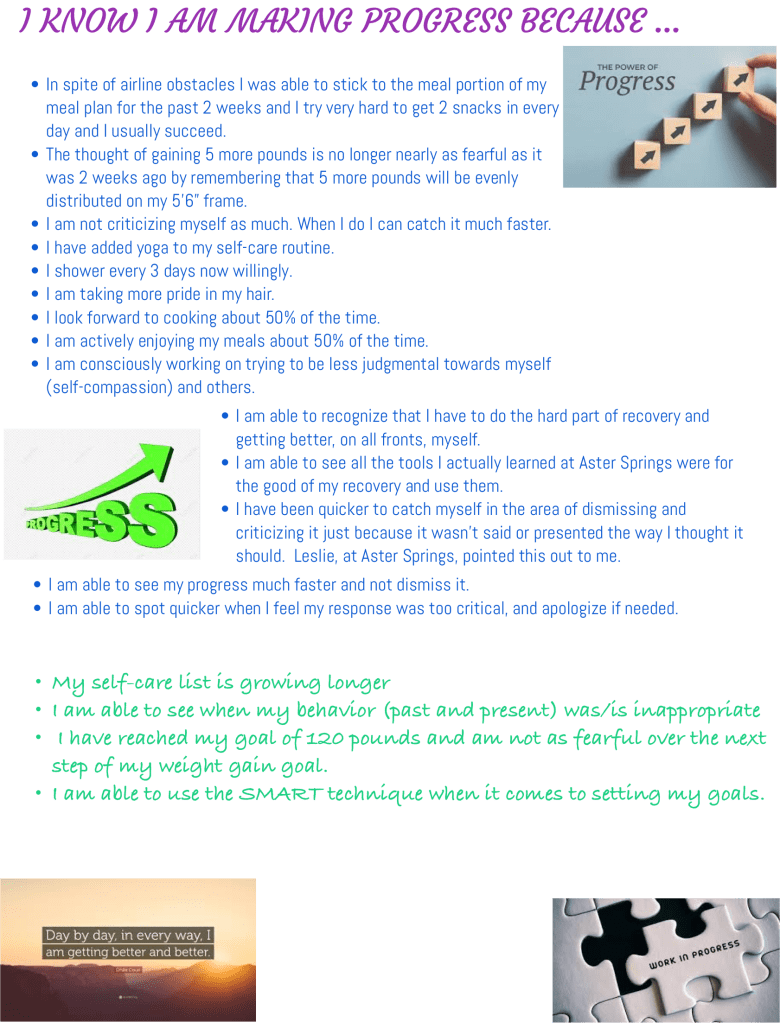
Keeping track of the progress we have made is imperative to the success of our recovery. We need to be able to recognize we are progressing, no matter how small the progress is. Some of our progress will show up under the Today’s Wins if you are keeping a gratitude journal. No matter whether you keep a gratitude journal or you don’t, having our progress in black and white is a great reminder of how far we have come.
My ‘I am making progress because’ list is something I add to whenever I feel the need to remind myself of the progress of my recovery. Another benefit to keeping track is that you can give it to your professional support team easily. This lets them see what you are making progress in. I myself, put each time I add to it a different color so I can see the growth.
I have put out a sample of my progress report to myself. Several templates for this type of list are out under the templates blog section. You can either print them (and there are several different templates) out there, or just use them to design your own. You don’t have to use a “pretty” page; it can just be written done in a spiral notebook. It is up to you.
FINAL THOUGHTS:
I know and believe that those of us who suffer from an ED of any type can beat it. It is hard work and at times feels impossible; but I am sure it is a goal that is obtainable to all of you out there.
KEEP Y0UR CHIN UP! Take baby steps towards your recovery, put one foot in front of the other and know, with a capital K, you CAN do it. Even if you can’t see it now, the world needs you!
Triggers are things or words someone says that we encounter that makes us very uncomfortable and possibly allows us to indulge in our eating disorder. These things can be something as simple as a number, the outfit someone wears, a situation and yes even a smell. We become so super sensitive to the item/words/smells/situations/places that we tend to close up mentally. Triggers can sometimes even cause somatic symptoms. One of my own triggers is so severe that I instantly become nauseated.
So what can we do when we find ourselves becoming triggered? This is when we need to open our toolbox and use some of the tools we have. Breathe, use distraction, use a CBT or a DBT technique if you are familiar with them just to name a few.
Make a list of things/words/smells/situations/places that you know are triggers to you. Then work with your professional support team to help you to figure out what tools in your toolbox might work for each thing that you know is triggering. This is called a ‘Cope Ahead Plan’. You are pre-planning ahead of time so you have options for when you may be triggered. Practice these tools BEFORE you need to use them. By practicing our tools when we are calm, they are more likely to come to mind much more quickly when we need them.
If we do get triggered by someone we need to ask ourselves a question…Was the person aware that their actions/words are triggering to us? If the answer to this question is yes, we have to make the decision as to whether we want this person in our lives. We can always terminate the conversation; though for us it may be hard to do since most of us are not able to stand up for ourselves in the beginning of our recovery journey. To do something like this takes practice. However, we NEED to realize that most people have no clue what may or may not trigger us or even what our individual triggers are. Becoming upset is normal and natural, but it is up to us to let the person know that their words are making us uncomfortable in a private setting. There is never a need to humiliate someone because we are triggered.
If the trigger is a situation, we can always remove ourselves from it. When I go out with others I always drive myself. This way I do not have to rely on someone who may not be ready to leave to stop and take me home. I can excuse myself (if needed make up an excuse, such as I have a bad headache) and just go home. Once I have removed myself I can reach out to someone within my support team and verbalize my emotions.
If the trigger is a place we can:
If the trigger is a particular smell, remove yourself from the area in order to not smell it any longer.
Anytime we are triggered we can use our breathing techniques we have learned to calm ourself, our mind and our body. DO NOT beat yourself up; look at what you can do the next time you encounter the trigger. Each time we handle any trigger we might have, it lets our brain know you are a strong person and you will not allow it to control you.
FINAL THOUGHTS:
I know and believe that those of us who suffer from an ED of any type can beat it. It is hard work and at times feels impossible; but I am sure it is a goal that is obtainable to all of you out there.
KEEP YOUR CHIN UP! Take baby steps towards your recovery, put one foot in front of the other and know, with a capital K, you CAN do it. Even if you can’t see it now, the world needs you!

Affirmations can be a great tool in our toolbox when fighting this disease of eating disorders. They can be used to motivate us, remind us that we are worth the struggle and of our successes, help us to stay the course, reaffirm our need for resilience and persistence and remind us that we ‘got this’. We can also use affirmations at any time no matter where we are or who we are with. We can silently speak our selected affirmations in our head as many times as we need to in order to calm ourselves down. If we are alone we can even say them out loud to ourselves. I have even spoken them to my dogs at times when I am really struggling. They listened and wagged their tails to let me know they heard me, though I doubt they actually understood. But that was okay because my mind/brain heard them. Affirmations ought to be short and easy to remember so you can use it whenever you need to. That is the joy of using affirmations.
Affirmations work because they help reshape your thought patterns, reinforce positive beliefs, and reduce negative self-talk. For affirmations to be most effective, they should be specific, believable, and emotionally meaningful to you. Repeating them with intention and visualization can further enhance their impact.
The brain can rewire itself based on repeated thoughts and experiences. When you consistently use affirmations, you strengthen neural pathways associated with positive thinking and self-belief. The brain filters information based on what you focus on. If you repeatedly affirm something (e.g., “I am confident”), your brain starts noticing opportunities and evidence that support this belief. Affirmations counteract negative self-talk and help reframe limiting beliefs. Over time, they can shift your internal dialogue from self-doubt to self-empowerment. Positive affirmations can put you in a constructive mindset, boosting motivation, resilience, and self-esteem. When you believe in your affirmations, you’re more likely to take actions that align with them, reinforcing the desired outcome.
If you are unable at this time to make your own affirmations you can google affirmations and more affirmations that you can remember will show up. Pick the ones that fit your situation you are struggling with to use. Since affirmations are one of the easiest tools to use that we can put in our toolbox, give them a try. It can only help you combat the negativity that tags along with our ED.
Here are some examples of affirmations you may want to try: “I am enough,” “I am valuable,” “I deserve happiness”, ”I am resilient,” “I am powerful,” “I can overcome anything”, “I am beautiful inside and out,” “I love and accept myself,” “I radiate positive energy”, “I am capable,” “I believe in myself,” “I am a leader”, “I am always learning and evolving,” “I embrace challenges,” “I am proud of my progress”.
FINAL THOUGHTS:
I know and believe that those of us who suffer from an ED of any type can beat it. It is hard work and at times feels impossible; but I am sure it is a goal that is obtainable to all of you out there.
KEEP YOUR CHIN UP! Take baby steps towards your recovery, put one foot in front of the other and know, with a capital K, you CAN do it. Even if you can’t see it now, the world needs you!
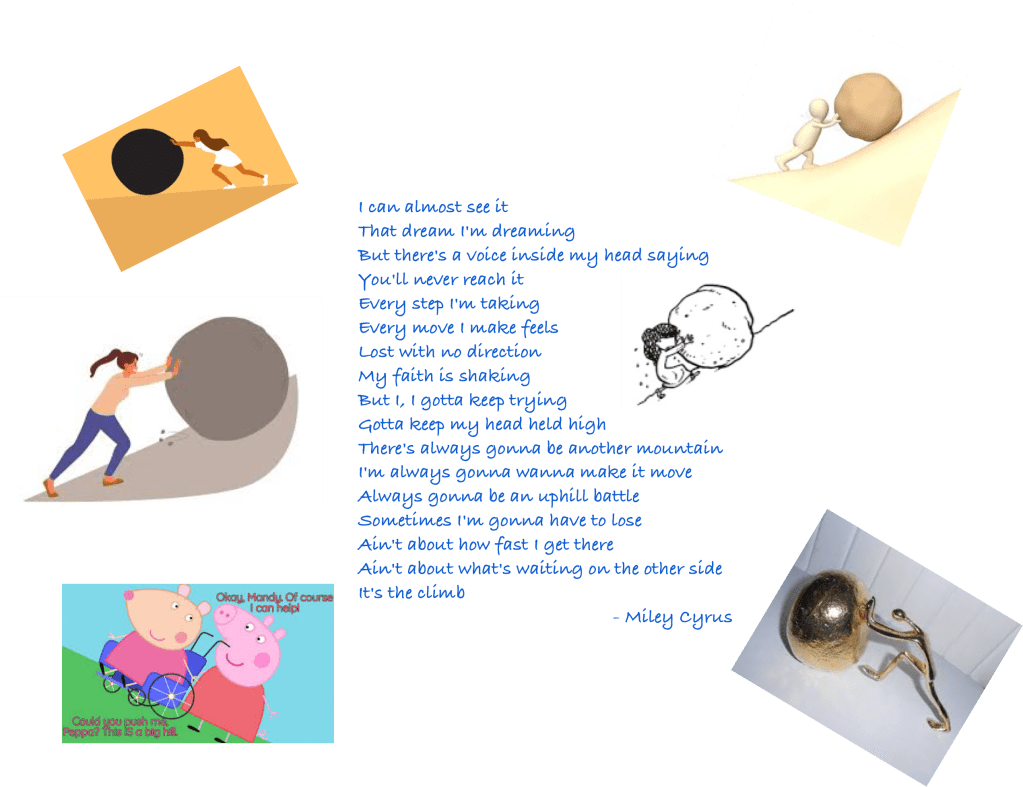

 Wings of Recovery