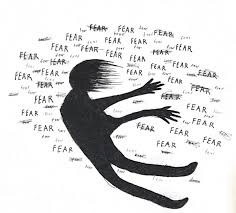
Fear is very real to those who have an eating disorder. We fear just about everything; from ourselves, to being a burden to others, failure, not being good enough, just to name a few. If you are like me, you live in fear 99% of the time. If you ask us what are we afraid of, most of us will say “I don’t know”. Could that answer indicate that we are afraid to look at much less confront our fears? Only you yourself can answer that question honestly.
My fears take both mental AND physical (called somatic) forms. I can feel it in my stomach (remember the butterflies in your stomach you got when you were afraid as a child) and in my throat which begins to physically hurt. Those are my somatic symptoms. The mental symptoms can be so overwhelming that we either fight (physically or verbally), freeze (withdraw into ourselves) or flight (we get the hell out of there or away from the person). I am quite sure that each of you reading this blog have experienced fear in one of these three ways. I, unfortunately, still tend to freeze. Then I beat myself up for standing there and taking whatever is causing the fear. Not very productive or positive of me. 2 years into recovery and that is an area that is still very hard for me to remember to use my tools from my toolbox.
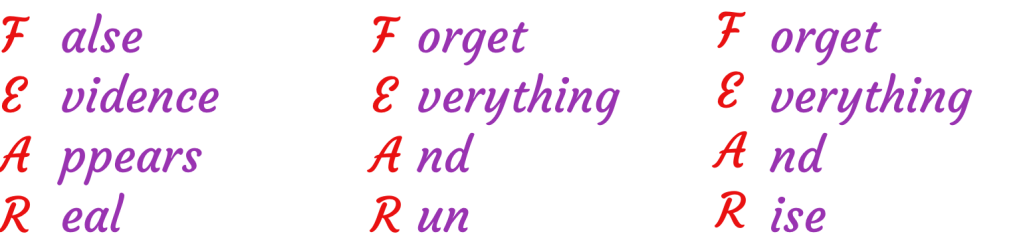
First let’s look at the different things fear can stand for; which one of the above saying do you find to hold the most truth for you?
So what can we do to help calm our fears as they arise? How do we deal with them both mentally and physically?
Using the first example could bring to mind that what we perceive leading to our feelings of fear may not be true. In order to see if this is the case we need to ‘Check the Facts’. What evidence do we have to allow us to stay in the fear mode? This can be extremely hard to do since our fear wants to stay in control. It can color our thoughts and view point in unhealthy ways. We have to be able to look at the actual facts, NOT the facts as we wish they were. Much of how we do this is based on our use of the words we tell ourselves. Do the words ‘never’ or ‘should’ appear in our version of the facts? Just because our friend does not answer a text in the time frame we think they should does not mean they don’t like us anymore. But that may be the first go thought we have. In this case, what real evidence do we have to support this belief? Our fear doesn’t allow us to see or consider that our friend may be very busy or driving or any other many things that keep them from answering us in a timely manner. Does the evidence back up what we are thinking or feeling? Has our friend said anything to indicate that our thoughts are real? Remember… False Evidence Appears Real! With practice and asking ourselves what is the real evidence to my thoughts we can begin to challenge our fear.
By using the second meaning we will get nowhere fast UNLESS we are in physical danger, in which case absolutely follow it and run if you are able. If we are not in physical danger, running doesn’t usually do much to alleviate or calm our fears. In fact, it may make them worse as we tend to beat ourselves up when we don’t handle a situation like we think we ‘should’ (oh no, there’s that nasty word ‘should’)! See my blog on the Power of Words to see why ‘should’ ought not to be in our vocabulary. The tool I find to be the most useful to counteract the fear I am feeling is a Cope Ahead Plan. This is a written out plan of things you can do (breathing, meditation, self-talk, self-soothing, etc.) when faced with a situation that has the potential to create a level of fear within us that may cause us to react in a manner that does not help our recovery to move forward. Your professional support team can be a huge asset when trying to create such a plan.
I personally like the third option, because I work best when I am actually doing something about whatever issue I am trying to tackle. However this may not be your personality. Forget everything and rise. Rise above the fear. Handle it on the spot so it does not fester in our minds and grow larger and larger. Here is where the Cope Ahead Plan you have put together helps a great deal. Read it every day; this helps to firm up the plan on how we could handle our fear before it strikes again.
One of the ways we can get a handle on our fear is to talk to it. Ask it what is causing the fear to appear at this time. Listen for the answer. Don’t be surprised if the answer you get is “everything”. Ask the fear if it can be more specific. Whatever comes immediately to mind may be the thing you fear the most. In my case, it is the fear of not being good enough. I then ask it to tell me “what will be good enough”. This question then enables me to start to examine what do I need to believe I am good enough. I can then use one of the above definitions of fear to begin to lower the level of the fear I feel. Your question(s) may be different from my questions; make the question(s) specific to you. If you aren’t able to come up with questions or answers your professional support team is there to help you. If you are able to ask questions directed to your fear, you are well on your way to lessening the level of it. This will not happen overnight it will take practice. Just start.
FINAL THOUGHTS:
I know and believe that those of us who suffer from an ED of any type can beat it. It is hard work and at times feels impossible; but I am sure it is a goal that is obtainable to all of you out there.
KEEP YOUR CHIN UP! Take baby steps towards your recovery, put one foot in front of the other and know, with a capital K, you CAN do it. Even if you can’t see it now, the world needs you!
 Wings of Recovery