Radical Acceptance

All of us who suffer from low or non-existent self-esteem tend to wonder and feel like “what’s wrong with me?” are constantly in search for an answer to this age long question.  This question can run our minds around in circles.  We have all been there.  To me this is an ever present question that I desperately sought and still seek an answer to.  By believing there is something inherently wrong with us we tend to gravitate towards emotions and thoughts of “I am unworthy of … “; “I don’t deserve …”; or even “I can’t do … because…”, fill in the blank with your own thoughts.  We are never able to truly relax and enjoy the life we have at that moment.

Radical acceptance is about fully accepting reality as it is, even when it’s painful or difficult. It means acknowledging the facts of a situation without trying to deny, fight, or change them. This doesn’t mean you approve of the situation or agree with it, it just means you recognize that it’s real. By accepting reality, you can reduce emotional suffering and focus your energy on what you can control, rather than being stuck in frustration or anger over things you can’t change. It’s a concept often used in mindfulness and therapy to help people cope with tough emotions and experiences. 

Philosopher and psychologist William James once said, “the first step in overcoming any misfortune is to allow it to be”.

The saying of “It is what it is” is a form of radical acceptance.  The situation is just that; and is neither good or bad.  ‘“It is what it is” has no judgement attached to it, just the facts of the situation; which is exactly what Radical Acceptance is.

ACCEPTANCE IS NOT:

saying what happened is okay

giving up or giving in.  

ACCEPTANCE IS:

acknowledging reality so you can marshal your psychological    and emotional resources to move forward.

Learning to accept reality, and then using your skills to be as effective as possible, is the path forward and the way to end suffering.

Practicing radical acceptance involves a few key steps to help you acknowledge reality and reduce emotional suffering. To practice the Radical Acceptance tools you need to notice what you’re resisting.  Pay attention to situations where you’re feeling anger, frustration, or denial. Ask yourself, “What am I struggling to accept right now?”.  Next comes the acknowledge reality step; clearly recognize the facts of the situation, even if they’re painful. Remind yourself, “This is the way things are, whether I like it or not.”  You also need to practice recognizing what you can and can’t control, which is to understand that while you can control your response, you can’t always control circumstances or other people.  Another step involves allowing yourself to feel by letting yourself experience the emotions that come with acceptance—whether it’s sadness, disappointment, or grief—without judgment.  Lastly we need to challenge unhelpful thoughts.  You might want to consider noticing thoughts like “This shouldn’t be happening!” and gently shift them to “It is happening, and I can handle it.”

Some of the tools we can use to help us to practice this technique are mindfulness.  Focus your thoughts on staying present. Avoid dwelling on how things could or should be. Ground yourself by paying attention to your breath or surroundings.  Practice self-compassion; be kind to yourself. Acceptance can be hard, and it’s okay to struggle with it.

Radical acceptance isn’t a one-time thing. You may need to remind yourself to accept reality over and over, especially in challenging situations.  It’s a skill that takes time to develop, but with practice, it can lead to less emotional suffering and greater inner peace.

Spend the next few minutes contemplating the role of acceptance in your life.  What are some things you are having a difficult time accepting?  Is this something I can control?  What skills do you have and can use to accept those things?

FINAL THOUGHTS:

I know and believe that those of us who suffer from an ED of any type can beat it.  It is hard work and at times feels impossible; but I am sure it is a goal that is obtainable to all of you out there.

KEEP YOUR CHIN UP!  Take baby steps towards your recovery, put one foot in front of the other and know, with a capital K, you CAN do it.  Even if you can’t see it now, the world needs you!

Fear

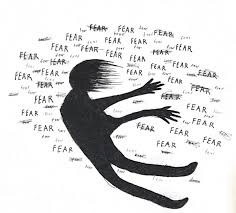
Fear is very real to those who have an eating disorder.  We fear just about everything; from ourselves, to being a burden to others, failure, not being good enough, just to name a few.  If you are like me, you live in fear 99% of the time.  If you ask us what are we afraid of, most of us will say “I don’t know”.  Could that answer indicate that we are afraid to look at much less confront our fears?  Only you yourself can answer that question honestly.

My fears take both mental AND physical (called somatic) forms.  I can feel it in my stomach (remember the butterflies in your stomach you got when you were afraid as a child) and in my throat which begins to physically hurt.  Those are my somatic symptoms.  The mental symptoms can be so overwhelming that we either fight (physically or verbally), freeze (withdraw into ourselves) or flight (we get the hell out of there or away from the person).  I am quite sure that each of you reading this blog have experienced fear in one of these three ways.  I, unfortunately, still tend to freeze.  Then I beat myself up for standing there and taking whatever is causing the fear.  Not very productive or positive of me.  2 years into recovery and that is an area that is still very hard for me to remember to use my tools from my toolbox.  

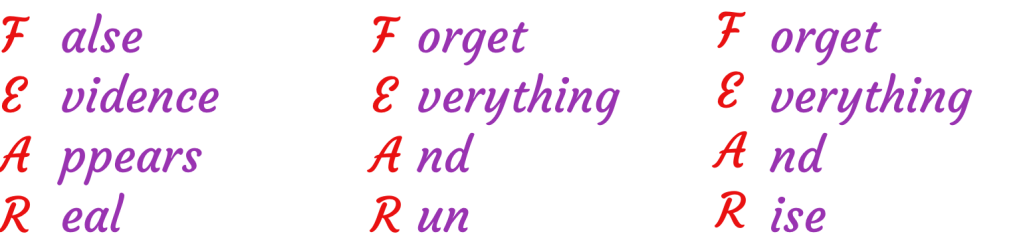
First let’s look at the different things fear can stand for; which one of the above saying do you find to hold the most truth for you?

So what can we do to help calm our fears as they arise?  How do we deal with them both mentally and physically? 

Using the first example could bring to mind that what we perceive leading to our feelings of fear may not be true.  In order to see if this is the case we need to ‘Check the Facts’.  What evidence do we have to allow us to stay in the fear mode?  This can be extremely hard to do since our fear wants to stay in control.  It can color our thoughts and view point in unhealthy ways.  We have to be able to look at the actual facts, NOT the facts as we wish they were.  Much of how we do this is based on our use of the words we tell ourselves.  Do the words ‘never’ or ‘should’ appear in our version of the facts?  Just because our friend does not answer a text in the time frame we think they should does not mean they don’t like us anymore.  But that may be the first go thought we have.  In this case, what real evidence do we have to support this belief?  Our fear  doesn’t allow us to see or consider that our friend may be very busy or driving or any other many things that keep them from answering us in a timely manner.   Does the evidence back up what we are thinking or feeling?  Has our friend said anything to indicate that our thoughts are real?  Remember… False Evidence Appears Real!  With practice and asking ourselves what is the real evidence to my thoughts we can begin to challenge our fear.

By using the second meaning we will get nowhere fast UNLESS we are in physical danger, in which case absolutely follow it and run if you are able.  If we are not in physical danger, running doesn’t usually do much to alleviate or calm our fears.  In fact, it may make them worse as we tend to beat ourselves up when we don’t handle a situation like we think we ‘should’ (oh no, there’s that nasty word ‘should’)!  See my blog on the Power of Words to see why ‘should’ ought not to be in our vocabulary.   The tool I find to be the most useful to counteract the fear I am feeling is a Cope Ahead Plan.  This is a written out plan of things you can do (breathing, meditation, self-talk, self-soothing, etc.) when faced with a situation that has the potential to create a level of fear within us that may cause us to react in a manner that does not help our recovery to move forward.  Your professional support team can be a huge asset when trying to create such a plan.

I personally like the third option, because I work best when I am actually doing something about whatever issue I am trying to tackle.  However this may not be your personality.  Forget everything and rise.  Rise above the fear.  Handle it on the spot so it does not fester in our minds and grow larger and larger.  Here is where the Cope Ahead Plan you have put together helps a great deal.  Read it every day; this helps to firm up the plan on how we could handle our fear before it strikes again.  

One of the ways we can get a handle on our fear is to talk to it.  Ask it what is causing the fear to appear at this time.  Listen for the answer.  Don’t be surprised if the answer you get is “everything”.  Ask the fear if it can be more specific.  Whatever comes immediately to mind may be the thing you fear the most.  In my case, it is the fear of not being good enough.  I then ask it to tell me “what will be good enough”.  This question then enables me to start to examine what do I need to believe I am good enough.  I can then use one of the above definitions of fear to begin to lower the level of the fear I feel.  Your question(s) may be different from my questions; make the question(s) specific to you.  If you aren’t able to come up with questions or answers your professional support team is there to help you.  If you are able to ask questions directed to your fear, you are well on your way to lessening the level of it.  This will not happen overnight it will take practice.  Just start.

FINAL THOUGHTS:

I know and believe that those of us who suffer from an ED of any type can beat it.  It is hard work and at times feels impossible; but I am sure it is a goal that is obtainable to all of you out there.

KEEP YOUR CHIN UP!  Take baby steps towards your recovery, put one foot in front of the other and know, with a capital K, you CAN do it.  Even if you can’t see it now, the world needs you!

Finding Purpose in Your Life

As persons with ED,  a lot of us realize that we feel as though we have no purpose in our lives…nothing we can see that defines us as unique individuals except our ED.   We feel lost and adrift in the huge sea of humanity.   We have little if any self-confidence and no idea where to turn or who to turn to.   All of our emotions feel overwhelming and out of control.  So is it any surprise we feel like we have no sense of purpose.   Who am I?  What good am I?  How can anyone care about me?

Finding a sense of purpose, however small can actually begin to answer these questions.  But how do I do that, you are probably asking?  Where do I start?  After all, you probably feel so little and inconsequential and can’t see what you have to contribute to anyone.   

Finding something to enable you to feel like you have a purpose will increase your sense of self-worth.  An increased sense of self-worth helps us to be able to see more clearly that you can and do have a purpose.   Everyone, including you,  has a purpose and something to contribute .  We can contribute without ever knowing we are.  Smiling at a cashier or a simple thank you at the market can contribute to making them feel good.  It definitely is a small thing, one we generally don’t think about, but it is true.  Sometimes a smile or a ‘have a nice day’ can work wonders because we don’t ever know what their day has been like.  Without ever knowing you have contributed something to someone, you have.  

No one is saying your purpose has to be as huge as saving the world or creating world peace.  Again, I say, start small; take baby steps.  By setting a purpose for each day, not matter how small, the bigger purpose you want will come.   Just getting up every morning with the idea of today is a new day is actually a purpose.  You got up for whatever reason and that was on purpose.  Your purpose for that moment was to get up and maybe make or straighten your bed up.  As your recovery lengthens and strengthens you may come up with other things that you find give you a sense of purpose.  Remember a sense of purpose is simply why you are here at this moment.  

For far too long, I questioned what is my purpose in this life.  I was at a loss to be able to tell anyone the answer to that question.  After all, I felt as though I had nothing to contribute that was worth anything.  I was adrift in my own head with the anorexia running through my head like an out of control freight train.  I could see nothing good about myself.  I tuned out anything good because I didn’t feel I deserved to feel good and was sure no one wanted to hear anything I might think or have to say.  I sat and made vision boards expressing every bit of anger, confusion and self-loathing I felt.  Along the way, on the few and far between days when I actually had a glimmer of hope, I was able to make some vision boards that expressed my hope for recovery.  I brought some of the positive boards with me when I went into inpatient treatment.  I shared them with my therapist who encouraged me to share them with the other clients.  The reaction was very positive, so my sense of purpose began to grow as I realized I could encourage women who suffered from eating disorders, some of their disorders which were different from mine.  But the thoughts, fears, emotions are the same no matter what variation of this disease you may have.

 When I got home after 2 1/2 months my sense of purpose was to allow my creativity in this area to flourish.   As my collection of boards grew, my creativity grew.  So did my sense of purpose.  I began to put together a book on DBT for Teens.  Those who I have shared it with encouraged me to keep going.  From that encouragement came the idea to start a blog.  I gave it thought for over a year wondering if anyone truly could benefit from anything I had to say.  I finally decided to take the plunge and do it.  When I began to write these blogs to share with you I realized that for now this is my purpose.  I will never know if anything I say in the blogs I write will help someone, though I hope it does.  For now that is my purpose.   Next year I may have a totally different purpose, who knows?  But for now I feel a real sense of purpose.

Finding your sense of purpose takes time.  Only you can decide what to do and where to begin on this quest which I believe helps a great deal towards beating this disease we suffer from.   Step by step you can find it.  Start small and don’t let anything or anyone get in your way.  You DO have a purpose .   For those of you reading this blog that have small kids and/or a partner you love, your purpose for now  may simply be to get better.  Your sense of purpose can and probably will change over time as you become physically and mentally healthier.  That is okay.   And in my opinion, that is the way it is supposed to be.  None of us is the same today as we were last year.  We change!  And with those changes can come a new purpose in our lives.  No need to let this overwhelm you, start small in seeking a purpose for your life.   The growth you go through will enable your sense of purpose to grow along with you.  Embrace finding a sense of purpose rather than being afraid of it.  Remember, there is no right or wrong when it comes to finding a positive sense of purpose.

FINAL THOUGHTS:

I know and believe that those of us who suffer from an ED of any type can beat it.  It is hard work and at times feels impossible; but I am sure it is a goal that is obtainable to all of you out there.

KEEP YOUR CHIN UP!  Take baby steps towards your recovery, put one foot in front of the other and know, with a capital K, you CAN do it.  Even if you can’t see it now, the world needs you!